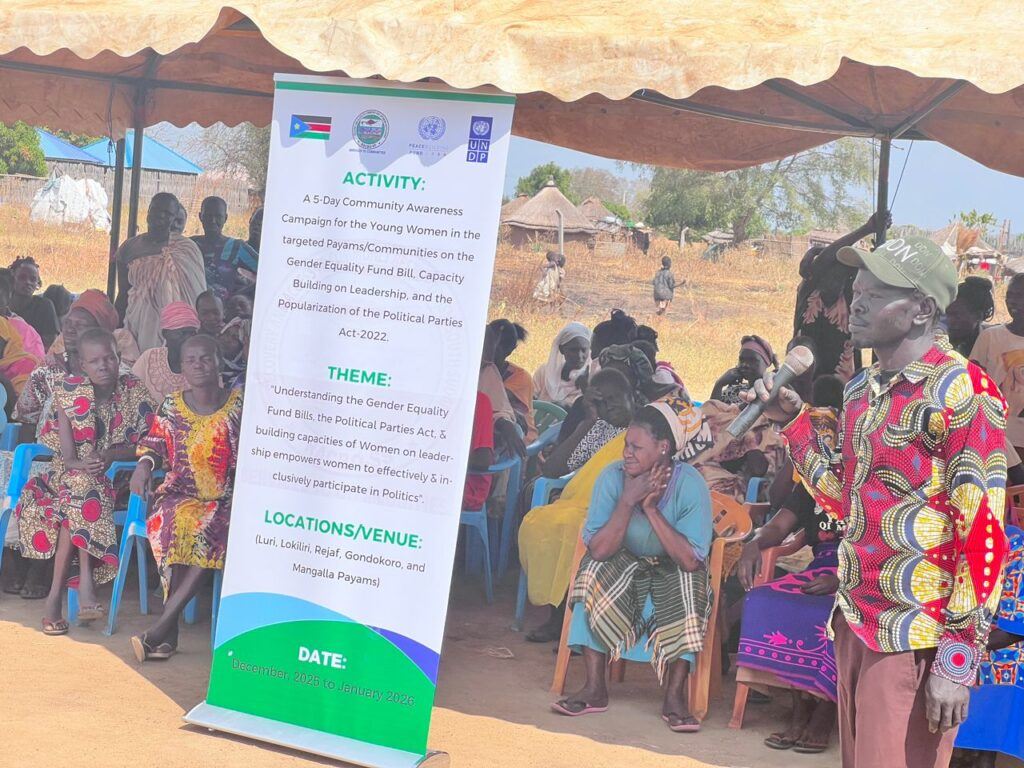
On 22 December 2025 in Lokiliri-Nesitu, we concluded our final activity of the year under the UNDP peacebuilding project: a five-day community awareness campaign for young women in targeted payams and communities. The campaign focused on three connected priorities: understanding the Gender Equality Fund Bill, building practical leadership capacity, and popularizing the Political Parties Act (Amendment) Act, 2022 so that young women can participate in politics effectively and inclusively. (Eye Radio)
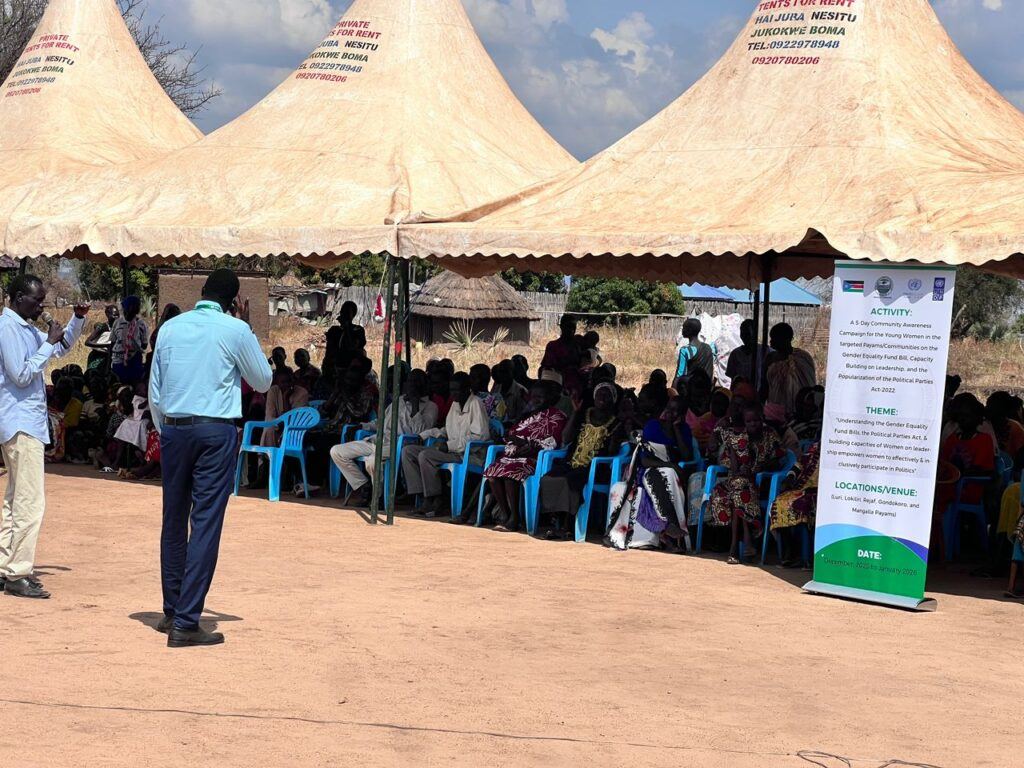
This activity was built on a simple conviction expressed in our theme: when women understand the rules, understand the resources being proposed, and gain leadership skills they can use in real situations, they are better prepared to take part in political life without being sidelined by uncertainty, intimidation, or misinformation. In many communities, the barriers facing young women are not only financial or cultural; they are also legal and procedural. People fear what they do not understand. So we used the five days to replace fear with clarity, and silence with readiness.
A major pillar of the campaign was civic learning on the Political Parties Act (Amendment) Act, 2022. We treated the law not as a distant document for lawyers in Juba, but as a set of rules that shapes who can organize politically, how parties are formed, and how political competition should work. Public “popularization” matters because political exclusion often begins at the information level. If young women do not know what the law says about party formation, membership requirements, and lawful participation, then politics remains an arena for those who already have networks, money, and confidence. This Act has been publicly discussed as setting conditions tied to party registration and nationwide representation, which is why community-level awareness is necessary, especially for new entrants into public life. (Radio Tamazuj)
The second pillar was the Gender Equality Fund Bill, presented in practical terms: what such a fund is meant to achieve, why it is being proposed, and why it matters for women’s leadership and participation. Across national reform processes, the idea of a Gender Equality Fund has been linked to broader efforts to advance women’s representation and implement affirmative action commitments, including the 35% benchmark referenced in peace and governance discussions. In policy work connected to women’s political leadership, the establishment of a Gender Equality Fund and an overseeing authority has been discussed as part of legal and institutional measures to support women’s empowerment and participation in governance. (mptf.undp.org)
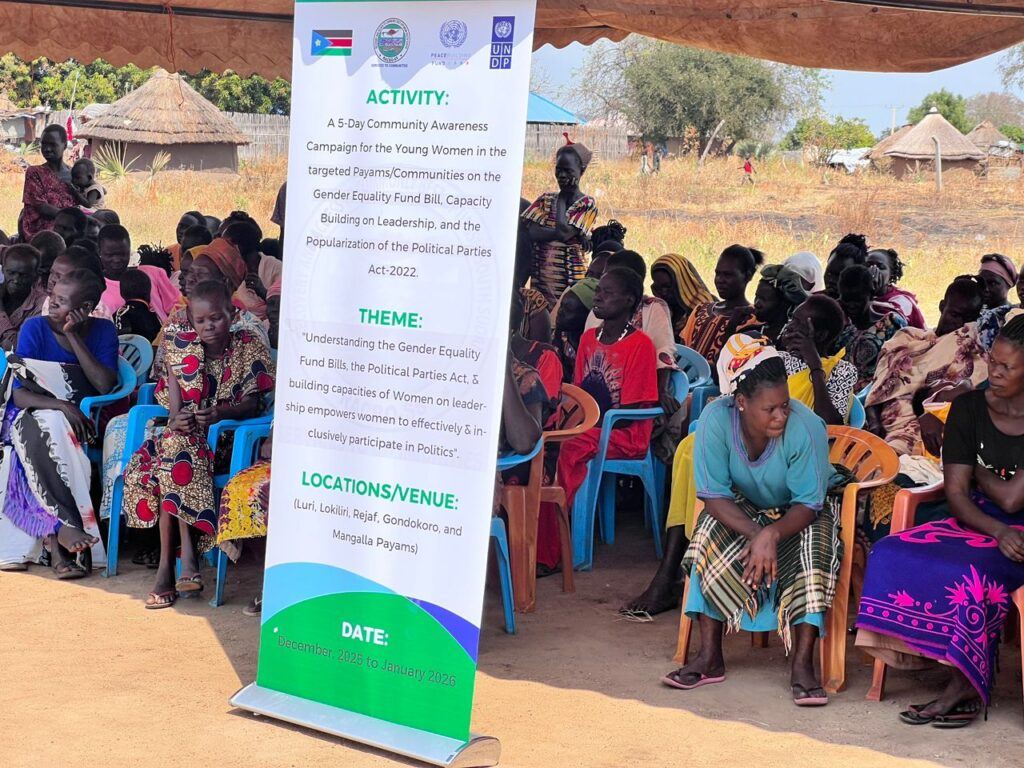
The third pillar, leadership capacity building, was the bridge between knowledge and action. Awareness alone does not prepare someone to lead, speak, negotiate, or hold space in rooms that have historically been dominated by men. The leadership sessions therefore focused on building confidence, communication discipline, decision-making, and the habit of participating constructively even when disagreement exists. This matters for peacebuilding. When women are equipped to participate in political and civic processes, communities gain more voices committed to dialogue, problem-solving, and accountability rather than violence or coercion.
Lokiliri and Nesitu are not abstract dots on a map. They are communities within Juba County that are experiencing development pressures and public service demands, including issues linked to roads, land, and settlement. In such places, political awareness and leadership capacity are not luxury topics. They determine who gets heard when decisions are made and disputes arise. (Eye Radio)
As we close 2025, this final activity stands as a clear signal of what peacebuilding should look like at the local level: equipping citizens, especially young women, with knowledge of the laws that govern political life, building leadership skills that can withstand real pressure, and encouraging participation that is inclusive, lawful, and community-centered. The work continues into the next cycle, but this five-day campaign ended the year with purpose: strengthening women’s readiness to take their place in political life, not as spectators, but as informed and capable actors.
Leave a Reply