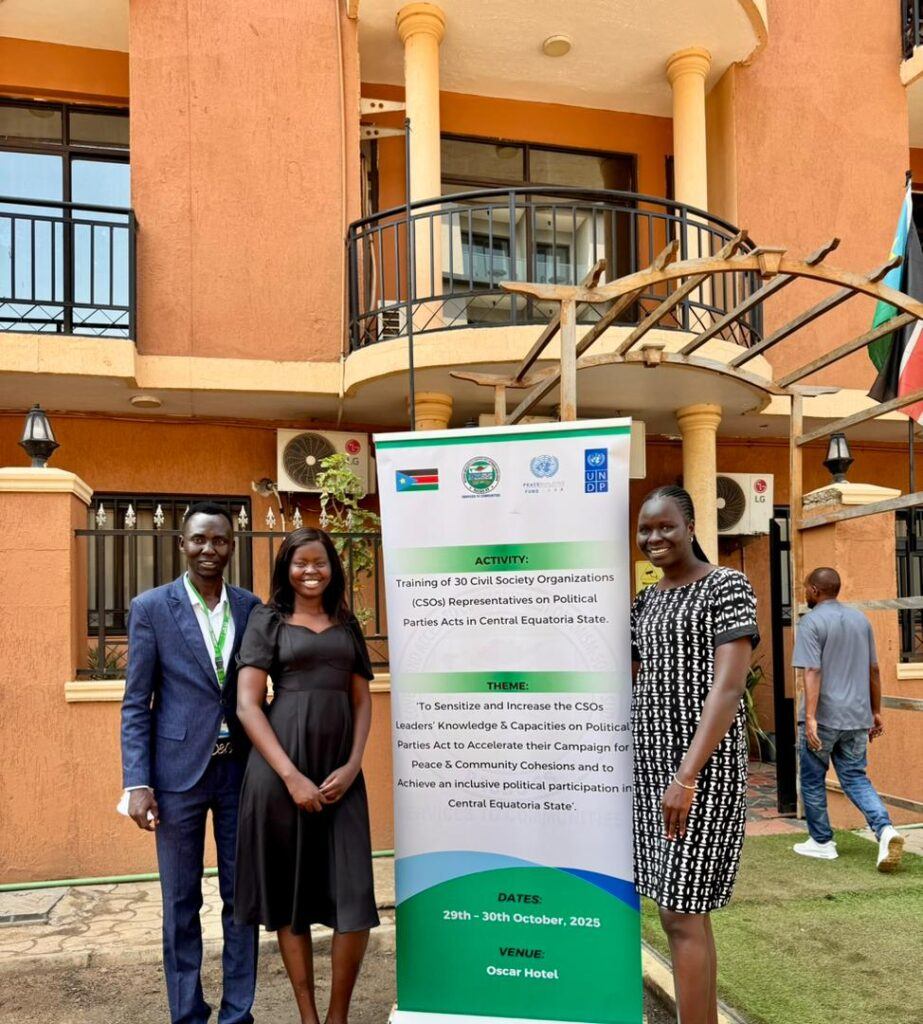
RACBO, in partnership with the United Nations Development Programme (UNDP) and with support from the United Nations Peacebuilding Fund (UNPB), successfully conducted a transformative two-day training session on October 29th and 30th, 2025, at the Oscar Hotel in Juba. The event brought together thirty representatives from civil society organizations (CSOs) across Central Equatoria State for an in-depth learning experience centered on the Political Parties Act — a key legal framework that shapes South Sudan’s democratic and political landscape.
For RACBO, this initiative was more than a routine workshop. It was a step forward in fulfilling its mission to empower individuals and institutions to participate meaningfully in the civic and social transformation of South Sudan. Guided by its vision of promoting Recovery and Access to Commonly Best Optimism, RACBO continues to strengthen community systems through dialogue, education, and inclusive engagement. The organization believes that an informed citizenry forms the foundation of a peaceful and democratic nation.
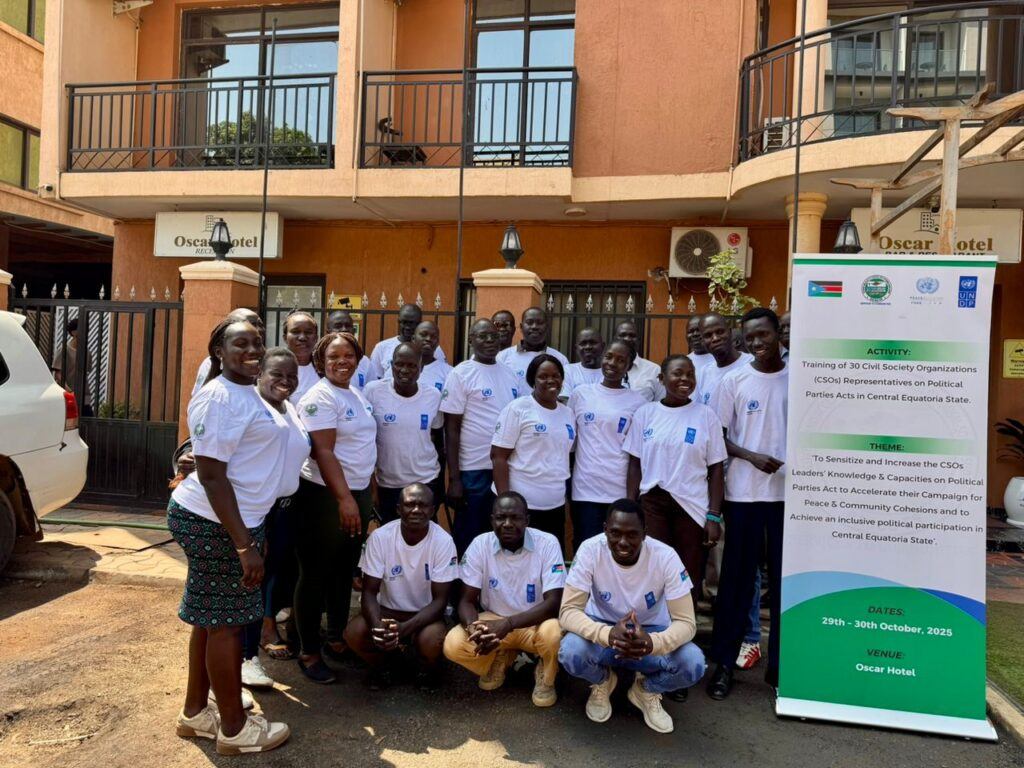
The training aimed to equip participants with essential knowledge of the Political Parties Act and to strengthen their capacity to engage constructively in governance processes. Through interactive sessions, practical exercises, and group discussions, participants explored how the Act regulates political parties, supports inclusivity, and ensures democratic participation. The facilitators emphasized that understanding the Act is not only a legal necessity but a civic responsibility that empowers citizens to hold institutions accountable.
Civil society plays a vital role in connecting communities to government structures. Yet, many CSO leaders often lack access to the resources and knowledge needed to engage effectively in policy discussions. This training sought to close that gap by providing tools that would enable them to interpret laws, advocate for reform, and promote peaceful coexistence among diverse groups.
A central focus of the workshop was the link between civic education and peacebuilding. Facilitators underscored that sustainable peace begins with awareness. When citizens understand their rights and duties, they become active participants in resolving conflicts peacefully. The sessions highlighted how civic education can counter misinformation, reduce tension, and promote dialogue at both community and national levels.
Participants were enthusiastic about the training’s participatory design. They engaged in scenario-based exercises that mirrored real-life governance challenges in South Sudan. Many shared their experiences from the field, noting that political awareness remains low in several communities, particularly among youth and women. They expressed gratitude for the training and pledged to share what they learned through local advocacy, community meetings, and radio programs.
One participant shared that before attending the workshop, they viewed the Political Parties Act as a document for politicians and legal experts. After the training, they understood that the Act affects every citizen — from how parties are registered to how leaders are elected. Another participant said the knowledge gained would help them organize civic awareness sessions in rural areas to promote participation and transparency.
The atmosphere throughout the two days was lively, collaborative, and hopeful. Each session encouraged critical thinking and reflection, giving CSO leaders an opportunity to examine their role in shaping democratic culture. The exchange of ideas among participants fostered a sense of unity and shared purpose, reinforcing the belief that peacebuilding is a collective responsibility.
RACBO’s core values — Integrity, Resilience, Innovation, Growth, and Sustainability — were evident throughout the event. Integrity guided transparent facilitation and open dialogue. Resilience was demonstrated by participants’ determination to learn despite existing challenges. Innovation shaped the delivery methods, which combined modern approaches with local perspectives. Growth was visible in the increased confidence of the participants, while sustainability reflected RACBO’s commitment to long-term impact through knowledge sharing and collaboration.
By the end of the training, participants received certificates in recognition of their dedication and active participation. However, the real achievement lay in the sense of empowerment and purpose that filled the room. The participants left not just as trainees, but as ambassadors of civic education and peace, ready to influence change within their organizations and communities.
In his closing remarks, a RACBO representative emphasized that peace is built from the ground up — in the hearts and minds of informed citizens. He noted that the Political Parties Act should not be seen as a distant policy but as a living guide that shapes how South Sudanese coexist and govern themselves. He reminded attendees that true nation-building begins with informed, responsible citizens who act with integrity and unity of purpose.
This successful collaboration between RACBO, UNDP, and UNPB demonstrates the power of partnerships in advancing peace, civic education, and inclusive governance. By strengthening the capacity of civil society, RACBO continues to lay the foundation for a future where South Sudanese citizens are not just spectators but active architects of peace and democracy.
Through this initiative, RACBO reaffirmed its dedication to creating opportunities for learning, dialogue, and transformation. The organization remains committed to empowering communities to rise above division, to participate meaningfully in governance, and to contribute to building a just and peaceful South Sudan — a nation united by knowledge, integrity, and shared optimism.
Leave a Reply