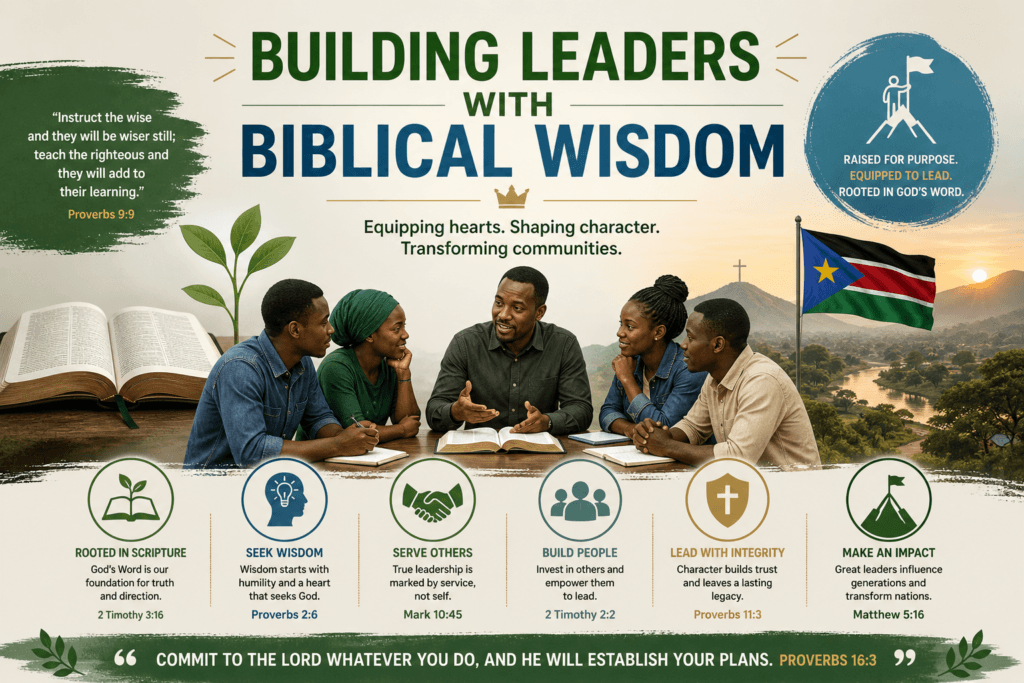
South Sudan has no shortage of people who can command. What we lack, again and again, is people who can lead. Command can be forced. Leadership must be earned. Command can silence a crowd. Leadership can calm a community. Command can take. Leadership can serve. And when a nation has suffered conflict, displacement, hunger, and deep mistrust, leadership becomes more than a skill. Leadership becomes a form of protection.
This is why theological training and biblical wisdom matter in 2026. Not because we want to turn civic life into a church service, and not because we want to argue religion with anyone. It matters because the Bible carries leadership lessons that speak to the exact weaknesses that keep breaking our communities: pride, corruption, revenge, tribal hatred, fear, lies, and neglect of the vulnerable. When those weaknesses rule, recovery stays slow, access stays blocked, and optimism becomes a word people laugh at. But when leaders are shaped by wisdom, integrity, courage, and service, communities become safer and more stable.
RACBO South Sudan exists to serve communities. Our name itself pushes us toward a clear direction: recovery and access, carried with commonly best optimism, expressed through real services to communities. That work is not only about what we deliver. It is also about the kind of leaders we become while delivering it, and the kind of leaders we help raise in the places we serve. Food, water, shelter, and training are important, but leadership is what makes those investments last.
Biblical wisdom begins with a truth many leaders dislike. Leadership is stewardship, not ownership. The Bible speaks often about stewardship because it understands the human temptation to treat power as a personal right. Whether we are talking about money, land, authority, or influence, the message is the same: what is placed in your hands is not yours to use for yourself. It is yours to manage for the good of others.
This is why Jesus warns about faithfulness in small things. A leader who cannot be trusted with small responsibility will not suddenly become trustworthy when the responsibility becomes big. In South Sudan, we often want leaders to be “big” quickly. We want the title, the vehicle, the escorts, the respect. But communities do not eat titles. Communities do not drink speeches. Communities do not heal from applause. Communities heal when leaders become faithful in small duties: keeping records, telling the truth, sharing fairly, showing up, listening, and protecting the weak.
Biblical wisdom also begins with the fear of God, which in simple language means moral accountability. Even if someone is not a Christian, the idea still stands: a leader must believe they answer to a higher standard than personal advantage. In our country, many people do wrong because they think there will be no consequence. They think nobody is watching. They think power will protect them. But a leader shaped by biblical wisdom carries a different inner voice. That inner voice says, “Even if nobody sees me, I am still accountable.”
That is integrity, and integrity is national medicine.
One of the most powerful leadership pictures in the Bible is servant leadership. Jesus says plainly that greatness is not found in dominating others but in serving them. This is not weak leadership. It is strong leadership under control. Servant leadership does not mean a leader has no authority. It means authority has a purpose: to protect life, to lift burdens, to set fair rules, and to guide people toward what is right.
In practical terms, servant leadership in South Sudan looks like a chief who refuses to take bribes in land cases. It looks like a local official who does not sell relief lists. It looks like a youth leader who calms his peers when rumors are spreading. It looks like a pastor who refuses tribal politics in the pulpit. It looks like a women’s leader who speaks for girls who are being pushed into early marriage. It looks like a community committee that chooses the most vulnerable households first, even when powerful relatives are pressuring them. Servant leadership is not talk. It is a pattern of choices that cost something.
The Bible also teaches that leadership requires wisdom, not only courage. Courage without wisdom becomes recklessness. Wisdom without courage becomes cowardice. South Sudan has suffered from both extremes. Some leaders have courage to fight but no wisdom to build. Others have wisdom to see what is wrong but no courage to confront it. Biblical leadership calls for both.
Look at the story of Nehemiah. He did not rebuild Jerusalem’s wall by shouting at people. He assessed the damage. He planned. He mobilized. He faced opposition with firmness. He organized security without turning the rebuilding into a revenge campaign. He corrected internal corruption and exploitation among his own people, because he understood something leaders often ignore: a community can be attacked from outside, but it can also be destroyed from inside by greedy leaders. Nehemiah’s leadership was practical, courageous, and morally clear. That is the kind of leadership South Sudan needs in 2026: leadership that builds while guarding the building process from sabotage, theft, and division.
Biblical wisdom also teaches justice. The prophets speak strongly against leaders who oppress the poor and manipulate the legal system. This is not a small point. In many South Sudanese communities, conflict grows because people feel justice is for the connected, not for the ordinary. When people believe the system is unfair, they stop using peaceful processes. They choose self-help, and self-help easily becomes violence. Justice is therefore not only a moral idea. Justice is conflict prevention.
Micah’s call to do justice, love mercy, and walk humbly speaks directly to leadership culture. Justice means fairness in decisions and in distribution. Mercy means understanding human weakness and not ruling with cruelty. Humility means remembering that leadership is not a throne, it is a burden you carry for others.
Mercy is especially important in a traumatized nation. South Sudan is full of people carrying grief. Some carry grief from cattle raids. Some carry grief from civil wars. Some carry grief from displacement, hunger, and disease. Trauma often shows itself as anger, suspicion, and harshness. A leader without mercy will punish people for wounds they did not choose. A leader with mercy will still enforce order, but they will do it with respect and with an eye toward healing.
This is where biblical wisdom helps leaders see people as people. Not as “cases,” not as “targets,” not as “opponents,” not as “tribes,” but as human beings made with dignity. When a leader sees people that way, their tone changes. Their decisions change. Their priorities change. And communities feel it quickly.
Another strong leadership lesson is the power of truth. The Bible is direct about lying. It does not treat lying as a clever tool. It treats lying as a destroyer of community life. Lies create fear. Lies create division. Lies create injustice. Lies create violence. In South Sudan, many conflicts begin with unverified stories. A rumor spreads, youth mobilize, and blood is shed before anyone checks facts. A leader shaped by biblical wisdom becomes a protector of truth. They slow things down. They ask questions. They verify. They refuse propaganda. They correct falsehood, even when falsehood benefits their side.
Truth-telling is one of the most needed leadership skills in 2026. Not because truth is easy, but because truth is costly. A leader who tells the truth may lose some short-term support. They may face threats. They may be mocked as weak. But in the long run, truth builds trust. And trust is the currency of recovery.
Look at Joseph’s story. Joseph rose to leadership in a foreign land because he was wise, disciplined, and faithful. He planned for a coming famine, saved resources, and protected nations from collapse. That story matters for South Sudan because our crises are not only sudden. Many of them are predictable: floods, hunger seasons, road cutoffs, disease outbreaks during rainy seasons, youth unrest during economic stress. A leader shaped by biblical wisdom learns to prepare. Preparation is not fear. Preparation is stewardship.
This connects directly to RACBO’s work. Relief is necessary, but preparedness reduces repeated suffering. Recovery is stronger when communities have plans, not only reactions. Biblical wisdom encourages leaders to think beyond today’s noise and to build systems that protect tomorrow’s children.
Biblical wisdom also teaches leaders to resist corruption. Corruption is often treated as a political problem, but it is also a spiritual and moral problem. It is a decision to use community resources for personal gain. It is theft dressed in authority. In the Bible, leaders who exploit people are condemned, not celebrated. And in real life, corruption produces the same fruit every time: poverty, anger, mistrust, weak services, and eventually violence.
In South Sudan, corruption is not only at high levels. It can appear in small places: demanding a “small thing” to add someone’s name to a list, selling a seat in a training program, stealing relief items, diverting fuel, inflating prices, using public office as a private shop. These small corruptions gather into a big sickness.
A leader shaped by biblical wisdom takes a firm stance early. They refuse the first bribe. They refuse the first dishonest shortcut. They keep records. They invite accountability. They understand that once corruption enters, it does not stay small. It grows and consumes everything.
Daniel’s story is important here. Daniel served in a system full of power politics, yet he remained faithful and clean. He did not compromise his integrity to survive. He was steady, consistent, and respected even by those who did not share his faith. That is leadership that creates public trust. South Sudan needs leaders like that, leaders who can operate in hard environments without becoming dirty.
Biblical wisdom also values community over ego. Many leaders collapse because their ego becomes bigger than the mission. Ego makes a leader impatient. Ego makes a leader reject correction. Ego makes a leader punish criticism. Ego makes a leader surround himself with praise-singers instead of truth-tellers. Ego is one of the fastest ways to turn leadership into disaster.
Moses is a leadership mirror here. Moses had moments of anger that cost him, but he also had moments of humility where he listened, delegated, and accepted wise advice. When Jethro advised Moses to share responsibilities, Moses accepted. This is a major leadership lesson: a leader who tries to do everything alone will burn out and will also become a bottleneck that slows community progress. Delegation is not weakness. Delegation is wise leadership.
In RACBO’s work, delegation looks like building community committees, training local volunteers, and sharing responsibility with trusted partners. It looks like empowering women and youth as real actors, not decorations. It looks like creating clear roles and accountability so programs do not depend on one person’s presence. Sustainability is impossible without this kind of shared leadership.
Biblical wisdom also elevates women’s leadership, even when culture resists it. Deborah led with courage and wisdom. Esther used influence with careful strategy to protect her people. These stories matter in South Sudan because women are already carrying much of the nation’s stability, yet they are often excluded from decision-making. A leader shaped by biblical wisdom cannot ignore women’s role. They will protect women, include women, and respect women’s voices, not as a favor, but as a moral duty and a practical necessity.
This matters for peacebuilding. Women often carry stronger instincts for protection of children and stronger resistance to revenge cycles, because they know the cost. When women are included in local peace efforts, the quality of decisions improves. When women are excluded, blind spots grow.
Biblical wisdom also teaches reconciliation. Jesus teaches peacemaking not as a hobby but as a blessing. Yet reconciliation is not pretending harm never happened. True reconciliation requires truth, confession, repentance, and repair. In South Sudan, people sometimes rush to say “forgive” without asking “what happened” and “what will prevent it from happening again.” That is not reconciliation. That is pressure. Biblical wisdom does not call leaders to silence victims. It calls leaders to pursue peace with truth.
This is a direct lesson for our communities in 2026. Peace cannot be built on lies. Unity cannot be forced while injustice is ignored. A leader shaped by biblical wisdom will create space for truth-telling and will guide communities toward repair, not endless revenge. They will resist political manipulation that uses tribal identity as a weapon. They will preach and practice a higher loyalty: loyalty to human life and to moral law.
But we must also address a danger: the misuse of the Bible. In our country, Scripture can be used to comfort, but it can also be used to control. Some leaders use the Bible to silence questions, to excuse oppression, or to bless their own power. That is spiritual abuse. Biblical wisdom rejects it. Jesus confronted religious hypocrisy strongly. He did not flatter leaders who used religion to exploit people. He exposed them.
So theological training in 2026 must not only teach verses. It must teach character. It must teach interpretation with integrity. It must teach leaders to separate God’s word from tribal propaganda and from personal ambition. It must teach leaders to serve the weak, not to sit above them.
A leader trained in biblical wisdom should be a person who protects the dignity of those who suffer. They should be the first to reject hate speech. They should be the first to calm youth when rumors rise. They should be the first to speak against corruption. They should be the first to defend girls and widows from exploitation. They should be the first to model fairness in relief distribution. They should be the first to admit mistakes and seek correction.
This is not fantasy. It is the fruit the Bible expects from leadership.
What does this mean for RACBO South Sudan as we serve communities in 2026?
It means we must treat leadership development as part of service, not as a separate project. When we work in communities, we should always be asking: who are the trusted voices here? Who are the emerging youth leaders? Who are the women leading quietly? Who are the elders holding the community together? Who are the faith leaders willing to tell the truth? How can we strengthen them with training, tools, and support?
It means we must model biblical leadership values in our operations. If we speak about integrity but our processes are secret, people will not believe us. If we speak about service but we treat people harshly at distribution sites, we betray our message. If we speak about truth but we exaggerate stories, we damage trust. If we speak about protecting the vulnerable but our programs leave them behind, our words become empty.
It also means we must build partnerships that strengthen local leadership. A service organization that ignores local leadership becomes a temporary visitor. A service organization that invests in local leaders becomes a builder of lasting capacity.
In March, as we focus on theological training, we should remember that many faith leaders in South Sudan are the closest leaders to the people. In many areas, a pastor or church elder is the first counselor, the first mediator, the first organizer, the first comforter in funerals, the first voice against revenge, and sometimes the only voice people trust. Strengthening their leadership skills is strengthening community stability.
But theological training must also include practical leadership skills: conflict resolution, trauma awareness, community mobilization, transparent resource management, protection of women and children, and ethical decision-making. The Bible does not teach leaders to live in the clouds. It teaches leaders to serve in the dust of real life.
There is another leadership lesson the Bible repeats: leadership must be rooted in character before it is rooted in charisma. Charisma can attract crowds, but character can sustain trust. South Sudan has seen many charismatic voices that later became destructive because character was missing. A leader who speaks well but steals will damage more than a silent leader who is honest. A leader who promises peace but fuels division will burn a nation. A leader who quotes Scripture but abuses women will poison families. That is why character matters.
In 2026, rising leaders must be trained to value character as their main asset. Skills can be learned. Resources can be found. Networks can be built. But once character is broken, trust becomes hard to rebuild.
This is why small disciplines matter. Keeping time. Keeping records. Telling the truth even when it is uncomfortable. Refusing bribes even when money is tight. Respecting women and girls even when peers mock you. Apologizing quickly when wrong. Checking facts before sharing news. Listening before speaking. These small disciplines create leaders communities can trust.
And trust, again, is the foundation of recovery and access.
South Sudan’s future will not be saved by one “big man.” It will be saved by many faithful men and women who carry responsibility with clean hands. The Bible calls such leaders blessed, not because they are perfect, but because they are trustworthy.
So here is the call of this month’s theme.
If you are a faith leader, treat your leadership as service, not as status. Teach truth. Protect the vulnerable. Refuse tribal politics in God’s name. Build peace patiently. Keep your hands clean with resources.
If you are a community leader, do not fear biblical wisdom. Learn from its discipline. Learn from its call to justice, mercy, humility, truth, and stewardship. These are not only religious ideas. These are community survival ideas.
If you are a youth, do not chase quick influence. Chase clean character. Learn skills. Find mentors. Build habits. Real leadership is slow, but it lasts.
If you are a woman, do not shrink your voice. The Bible itself honors women who led with courage and wisdom. Your leadership is needed for community stability and for protection of children.
And if you are part of RACBO South Sudan, keep our mission simple and serious. Serve communities. Expand recovery and access. Carry optimism through disciplined action. Strengthen leaders who will still be standing when projects end, leaders who will protect trust, dignity, and peace long after the distribution trucks are gone. Biblical wisdom will not solve every problem in South Sudan. But it can shape the kind of leaders who stop repeating the same sins that keep breaking the nation. And that is not small. That is how a country begins to heal.
Leave a Reply