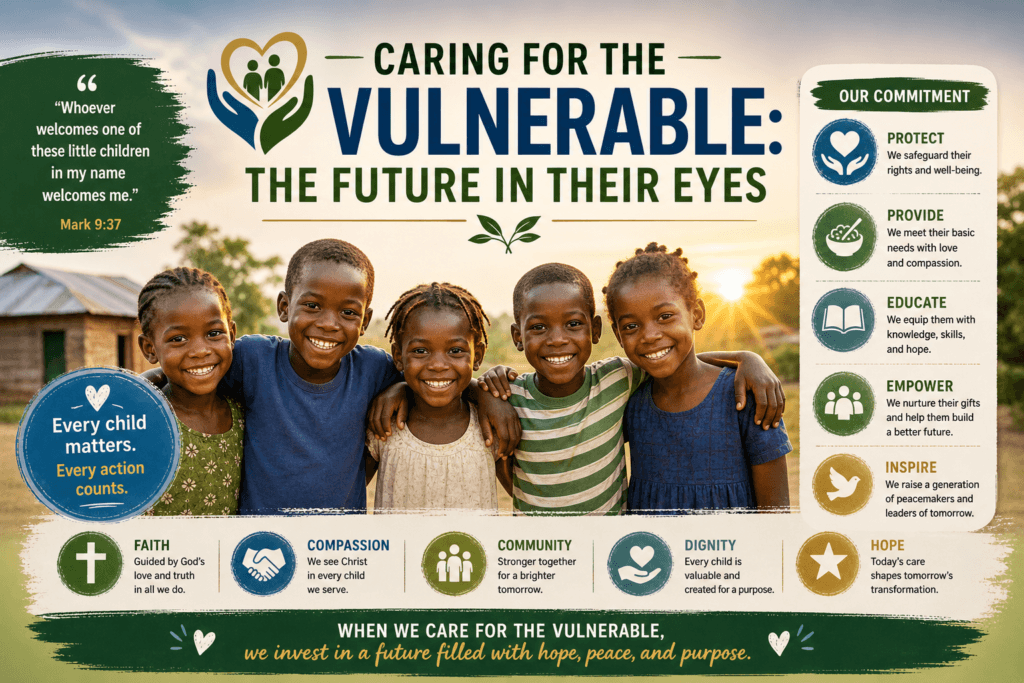
When a country is wounded, the first place you see the wound is in the eyes of children. Adults learn how to hide pain, how to speak bravely while shaking inside, how to pretend things are normal because life must move. But children do not pretend well. They show you the truth. They show you what fear looks like. They show you what hunger does to a body. They show you what displacement does to the mind. They show you what it means to grow up without a stable home, without safety, without a clear sense of tomorrow.
In South Sudan, the vulnerable are not a small group. Vulnerability is everywhere, but it falls hardest on those with the least protection: children, orphans, widows, the elderly, and people living with disabilities. Among them, children are the most urgent, because children are not only suffering now. They are also becoming the adults who will either rebuild this nation or repeat its destruction. If we lose the children, we do not only lose a generation. We lose the future.
RACBO South Sudan exists to serve communities through recovery and access, guided by integrity and a steady belief that communities can rise again. That belief becomes real when we choose to protect those who cannot protect themselves. This is not only charity. It is nation-building. It is peacebuilding. It is the smartest long-term investment a society can make.
A child who is safe grows into an adult who is calmer, more stable, more able to learn, and more able to work with others. A child who is unsafe grows into an adult who may carry anger like a weapon, because that is what life taught them. A child who eats well and learns well becomes a worker, a teacher, a builder, a leader. A child who grows up hungry and traumatized may become easy prey for manipulation, whether by criminals, armed groups, or political actors who trade small money for big violence.
This is why caring for the vulnerable is not a soft subject for emotional speeches. It is a hard subject for serious planning.
South Sudanese children face many threats, and they are not mysteries. Conflict separates families. Displacement creates crowded living where privacy and protection are weak. Floods destroy homes and farms, then hunger follows. Disease spreads where water is dirty and sanitation is weak. Poverty pushes families into painful choices. Sometimes a girl is married off early because the family thinks dowry will save the household from starvation. Sometimes a boy is sent to work in risky places because school feels impossible. Sometimes children are left with relatives who are already struggling, and the care becomes thin, not because relatives do not love them, but because they cannot carry the weight alone.
Orphans carry a special burden. They do not only grieve a parent. They also lose a shield. Many orphans become invisible inside households that are struggling. They may eat last. They may be taken out of school first. They may be sent to do the hardest labor. They may be blamed for misfortunes. They may be treated as if they are a burden rather than a child with dignity. Some orphans end up on the streets. Some move from place to place. Some end up in early marriage or exploitation because nobody is watching closely.
When we talk about orphans, we must not only talk about pity. We must talk about responsibility. A society that abandons its orphans is teaching itself cruelty, and cruelty never stays limited. It spreads. It spreads into families. It spreads into politics. It spreads into the way people treat each other during crises. A society that protects its orphans is training itself in mercy and discipline, and those are qualities that reduce conflict.
This is why the future can be seen in the eyes of vulnerable children. They are asking one question, even when they do not have the words: will anyone protect me?
In 2026, RACBO South Sudan must keep answering that question with actions that restore safety, dignity, and opportunity. Not perfect actions. Not actions that claim to solve everything. But actions that prove we are serious about service to communities and serious about integrity.
The first thing vulnerable children need is safety. Safety is basic, yet in many places it is not guaranteed. Safety means children are protected from violence, abuse, neglect, and exploitation. Safety means a child can sleep without fear. Safety means a girl can walk to water or school without harassment. Safety means a boy is not recruited into violence or crime. Safety means children are not used as labor tools until childhood is stolen from them.
Safety begins in the community. A community must choose to be a shield around its children. This includes the simplest moral rules: do not harm children. Do not use children. Do not trade children for money. Do not force children into marriage. Do not treat an orphan as a servant. Do not ignore abuse because the abuser is powerful or related to someone important. When a community tolerates harm to children, it is not only harming the child. It is harming its own future.
But safety also requires systems, not only moral speeches. Communities need reporting channels that are safe. They need local protection committees that include women, elders, youth, and faith leaders who can intervene early. They need trusted referral pathways to health support, counseling, and where possible, legal support. They need public conversations that break the culture of silence around abuse. Silence is one of the strongest friends of harm.
RACBO’s role in 2026 is to strengthen these local systems wherever we work. We may not run formal courts, but we can support protective habits. We can train community volunteers on child protection awareness. We can encourage communities to set simple rules for safe spaces, schools, and public distribution sites. We can work with local leaders to ensure vulnerable children are identified and supported, not ignored. We can help create safer access to services so that a child is not endangered simply by seeking help.
The second thing vulnerable children need is stable care. A child needs a consistent caregiver who provides affection, discipline, and protection. When children lose parents, the best care often comes from extended family, but extended family also needs support. Too often, families take in orphaned children and become overwhelmed, especially when they are already poor. Without support, care becomes strained, and the child feels it.
This is where community-based support matters more than big promises. Simple support can change everything: school materials, food support during the hardest season, psychosocial support for the caregiver and the child, livelihood support for the household so they can provide without collapsing, and community recognition that caring for orphans is honorable, not a burden that should be mocked.
In many places, the best child care is not found in institutions. It is found in families, when families are supported. That support can be modest and still powerful. The goal is not to create dependence. The goal is to keep a child inside a stable, protective environment where they can grow normally.
The third thing vulnerable children need is education, including basic literacy and life skills. Education is not only a pathway to jobs. Education is a pathway to dignity. A child who can read becomes harder to deceive. A child who can count becomes harder to cheat. A child who learns history and civic responsibility becomes harder to manipulate into tribal hatred. A child who learns practical skills becomes more resilient during economic shocks.
But education in South Sudan is often fragile. Schools can be far. Teachers can be few. Families can be too poor to provide materials. Insecurity can make travel unsafe. Displacement can interrupt learning for years. Some children become teenagers without basic literacy, not because they were lazy, but because life never gave them a stable chance.
In 2026, caring for the vulnerable must include supporting learning in any form that fits the community. Sometimes that means keeping children in school by helping with small barriers like uniforms, books, and fees where possible. Sometimes it means supporting catch-up learning for children who missed years. Sometimes it means supporting community learning circles. Sometimes it means supporting teachers with simple materials and motivation. Sometimes it means supporting safe school environments, especially for girls.
Education is also protection. A child in school is less likely to be recruited into violence. A girl who stays in school is less likely to be pushed into early marriage. A child who learns in a safe environment develops social skills that support peace, such as cooperation and respect.
RACBO cannot replace the education system, but we can support access where we work and partner with others when possible. Our message should also be clear: a nation that does not educate its vulnerable children is choosing long-term instability.
The fourth thing vulnerable children need is health and nutrition. A hungry child does not learn well. A sick child does not play well. A malnourished child carries long-term damage that can affect body growth and mental development. Many child illnesses are preventable when clean water, hygiene, and basic health access exist. Yet many communities still struggle with these basics.
So caring for vulnerable children is connected to WASH and health access. Clean water reduces disease. Soap and hygiene education reduce infections. Safe latrines reduce outbreaks. Timely referrals save lives. Community awareness can correct harmful myths that delay treatment.
This is not separate from child care. It is child care.
In 2026, RACBO’s work in relief, water access, hygiene promotion, and community health awareness should keep children at the center. Every borehole repaired is not only a technical success. It is a child protected from waterborne disease. Every hygiene session is not only a training activity. It is a classroom protected from outbreaks. Every timely referral is not only a medical action. It is a family’s future protected from preventable loss.
The fifth thing vulnerable children need is psychological safety. Trauma does not only live in adults. Children carry trauma too, and it can shape their entire personality. A child who has witnessed violence may become aggressive, withdrawn, fearful, or unable to concentrate. A child who has been displaced repeatedly may struggle to trust any stable plan. A child who has lost parents may carry grief so heavy it turns into anger. Sometimes children act out, and adults label them as bad, when they are actually wounded.
Psychosocial support does not always require large clinics. Sometimes it begins with caregivers who understand trauma and respond with patience rather than harsh punishment. Sometimes it begins with safe spaces where children can play and express emotions. Sometimes it begins with faith communities offering comfort and community belonging. Sometimes it begins with a trained community counselor or volunteer who can listen and guide families to support. Sometimes it begins with restoring routines: school, play, chores, and family time. Routines tell a child’s brain that life is returning to normal.
RACBO’s approach in 2026 must treat psychosocial support as part of recovery, not as a luxury. Recovery is not only building structures. Recovery is also restoring minds.
There is another area that affects vulnerable children deeply: identity and documentation. Many children lack birth registration, and that can later block access to school, exams, services, and legal protection. In crisis settings, documentation is often lost. Families move quickly. Records disappear. This creates long-term vulnerability.
Where possible, community awareness about documentation, and support through partnerships, can reduce this hidden vulnerability. A child’s name and identity matter. It is part of dignity.
Caring for the vulnerable also requires honesty about abuse and exploitation. Exploitation often increases during crisis. Some people take advantage of desperation. Some demand favors. Some exploit children as labor. Some exploit girls through coerced relationships. A community that refuses to speak about these realities is allowing them to grow.
In 2026, RACBO should use its platform to support a culture where exploitation is rejected as shameful. This must be done carefully, with respect for safety and confidentiality, but it must be done. Communities can protect children better when they name the threat clearly.
Integrity matters here. If we speak about protection but our own processes expose children to risk, we betray our mission. Distribution sites must be safe. Community meetings must be safe. Staff and volunteers must be trained to behave with discipline and respect. Complaints must be taken seriously. No organization can claim community service while ignoring harm inside its own work.
Resilience matters too. Vulnerable children need consistent support, not attention that comes and goes. A child who has experienced loss is sensitive to abandonment. When support appears and disappears suddenly, it can deepen distrust. This does not mean we can promise endless resources. It means we can communicate clearly, plan carefully, and build local capacity so support does not depend only on outside presence.
Innovation matters because South Sudan’s realities require creative, low-cost solutions. In many places, professional services are limited. So communities must use what they have: local volunteers, faith leaders, women’s groups, youth groups, teachers, elders, and existing community structures. Innovation can mean training local caregivers in simple psychosocial support. It can mean mobile outreach for hygiene and nutrition awareness. It can mean community mapping of vulnerable children so they are not missed. It can mean small learning circles for children who have fallen behind. It can mean linking savings groups with child support priorities. It can mean using local radio messages that encourage protection and schooling.
Growth and sustainability matter because children are not a one-month project. Childhood is a long journey. Systems that support children must be built to last. This means strengthening families, strengthening community structures, strengthening schools, strengthening water access, and strengthening local leadership that values children as the future.
When a community protects children, it is also protecting peace. Children who grow up seeing fairness are more likely to practice fairness. Children who grow up with stable care are more likely to build stable families. Children who grow up with education are more likely to solve problems through thinking rather than violence. Children who grow up with dignity are less likely to seek dignity through domination.
This is why caring for the vulnerable is peace work.
In South Sudan, many conflicts are renewed by young people who never learned peaceful problem-solving. They learned survival. They learned revenge. They learned tribal pride as defense. They learned that power belongs to those who can harm others. Those lessons were learned because adults failed to protect childhood.
If we want different adults tomorrow, we must protect children today.
This includes teaching children a healthier sense of identity. A child can love their community without hating another. A child can be proud without being superior. A child can learn that another tribe is still human. This teaching begins at home, in schools, and in faith communities. It is reinforced by what children observe in adult behavior. When adults spread hate, children learn hate. When adults practice respect, children learn respect.
RACBO’s voice in 2026 should keep promoting unity as protection for children. A divided society is unsafe for children. A society that values unity makes it harder for violence to recruit youth later.
So what can communities do now, beyond waiting for organizations?
They can identify vulnerable children openly, without stigma. They can create a community list that is used for support, not for shame. They can agree on protection rules for public spaces. They can ensure that orphans are not used as free labor. They can ensure that girls are protected and encouraged to stay in school. They can ensure that children with disabilities are included, not hidden. They can challenge early marriage practices that are driven by desperation, and seek alternatives through community support and livelihood solutions. They can create a simple rotation of support for the most strained households, so no family carrying orphans is left alone.
Communities can also choose to honor those who care for orphans. Public honor matters. It changes culture. When caring for orphans is respected, more families are willing to do it, and they do it with pride rather than resentment. When caring for orphans is mocked, fewer people step forward, and the child suffers.
Faith communities can do a lot here. Churches and mosques can organize support circles for caregivers. They can mobilize small contributions. They can provide counseling and belonging. They can teach protection as a moral duty. They can speak against exploitation. They can encourage men to protect children, not only provide money. They can encourage youth to volunteer in child support activities, such as tutoring and safe play initiatives.
Youth themselves can become guardians of the future. A young person does not need a title to protect children. Youth can escort younger children to school in unsafe areas. Youth can volunteer as tutors. Youth can help with cleanup and water point protection. Youth can speak against harmful peer behavior. Youth can model respect for girls. Youth can refuse recruitment into violence and instead build safe community spaces.
Women, as the daily caregivers in many households, already carry this work. But women should not carry it alone. Men must share responsibility. A society that pushes child care only onto women is weakening itself. Protecting children is a community duty.
Now, what should partners and supporters understand about child care in South Sudan?
They should understand that the most powerful interventions are often the ones that strengthen families and communities rather than replace them. They should understand that dignity matters. A family caring for orphans should not be treated as a beggar. They should be treated as a protector doing honorable work. Support should be given in a way that respects pride. They should understand that consistency matters. Short, one-time support can help, but sustainable change comes from ongoing systems: education support, livelihoods support, water access, health access, and community protection structures.
They should also understand that child protection is sensitive. It requires confidentiality, trust, and cultural awareness. It requires training. It requires safe reporting. It requires careful messaging that protects survivors rather than exposing them.
For RACBO South Sudan, the mission remains clear. We serve communities. In 2026, serving communities must keep placing vulnerable children in the center, because children are the measure of whether recovery is real.
Recovery is not real if children are still unsafe.
Access is not real if children cannot reach school, water, and health support.
Optimism is not real if children grow up believing violence is normal.
Integrity is not real if orphans are exploited while adults stay silent.
So as we move forward this year, we should treat every child we encounter as a national responsibility. Not because we want to carry guilt, but because we want to carry purpose. A child is not only someone’s son or daughter. A child is a future citizen. A future worker. A future mother. A future father. A future leader. A future peacemaker.
If you want to see what South Sudan will look like in ten or twenty years, do not look only at government buildings. Look at the children in the villages and settlements. Look at whether they are safe. Look at whether they are learning. Look at whether they are fed. Look at whether they are smiling freely. Look at whether they can play without fear. Look at whether they are treated with dignity.
That is the future in their eyes.
And that is why caring for the vulnerable is not optional for RACBO South Sudan. It is central to who we are. It is central to recovery. It is central to access. It is central to building a nation that does not keep repeating the same tragedy.
In 2026, let this be our shared promise as communities, leaders, and partners: we will not abandon the children. We will not treat orphans as invisible. We will not allow exploitation to hide behind silence. We will build protection systems that fit local life. We will strengthen families who carry the burden. We will keep children learning. We will protect girls from being traded away by desperation. We will keep speaking truth even when it is uncomfortable. We will keep serving with integrity even when resources are limited.
Because when we protect the vulnerable, we protect the nation.
Leave a Reply