Christianity in South Sudan is not new. Churches stand in towns and villages. Bibles are read. Songs are sung. Prayers rise every day. Yet the deeper question remains: how is the Word lived?
To live the Word is to move beyond words. It is to carry faith into daily life. It is to turn belief into action. In a country shaped by conflict, displacement, and rebuilding, practical Christianity is not optional. It is necessary.
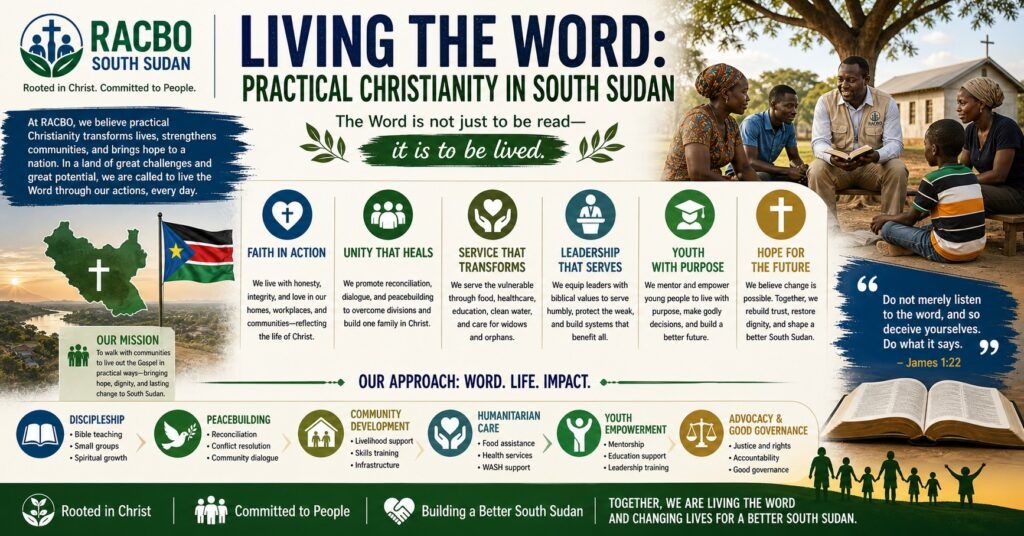
Practical Christianity begins with character. The teachings of Jesus Christ call for honesty, humility, patience, and love. These are not ideas for Sunday alone. They are needed in offices, markets, homes, and leadership. When a leader chooses truth over corruption, that is Christianity in action. When a worker refuses to steal, even when unpaid, that is faith lived out. When a neighbor forgives instead of seeking revenge, that is the Gospel made visible.
In South Sudan, community life is strong. Families, clans, and churches shape identity. This creates both opportunity and responsibility. Faith must guide relationships. Tribal divisions cannot stand where Christ calls for unity. If people gather in churches but divide outside them, then the Word has not yet taken root. Practical Christianity demands that unity be practiced, not just preached.
Service is another pillar. Many communities struggle with poverty, hunger, and lack of basic services. The church cannot only speak about heaven while people suffer on earth. Feeding the hungry, caring for the sick, educating children, and supporting widows are all acts of faith. When believers respond to these needs, they reflect the life of Christ. Service becomes the language of the Gospel.
Leadership is central to this transformation. South Sudan needs leaders shaped by values, not just power. Practical Christianity forms leaders who serve, not dominate. A Christian leader listens. A Christian leader protects the weak. A Christian leader builds systems that benefit all, not a few. This kind of leadership restores trust and creates stability.
Youth play a key role. Many young people are searching for direction. They see religion around them, but they also see contradictions. They need examples, not only sermons. When they see faith lived with consistency, they begin to believe again. Practical Christianity gives them a path. It shows that faith can shape careers, decisions, and relationships.
Challenges remain. Poverty pressures people to compromise. Conflict creates fear and mistrust. Political divisions influence even church spaces. Yet these challenges do not weaken the call to live the Word. They make it more urgent. Faith that survives hardship becomes stronger and more credible.
The future of South Sudan depends not only on policies and agreements, but also on people. Systems matter, but people run systems. When individuals change, communities follow. When communities change, the nation begins to heal. Practical Christianity works from the inside out. It transforms hearts, then actions, then society.
Living the Word is not about perfection. It is about direction. It is about choosing daily to align actions with belief. It is about small, consistent steps that reflect faith in real life. In South Sudan, this kind of Christianity can rebuild trust, restore dignity, and strengthen unity.
The Word must not remain on pages. It must be seen in lives.
Leave a Reply