In South Sudan, peace is not only the absence of gunfire. Peace is also a full granary. Peace is a school fee paid without shame. Peace is a mother who can buy medicine on the same day her child falls sick. Peace is a young man who earns an honest income and does not need to be mobilized for violence. Peace is a market that stays open because people are trading, not hiding. Peace is a family that can plan next month, not only survive this week.
That is why livelihoods matter. They are not just “development talk.” They are conflict prevention. They are dignity. They are recovery in the most practical sense. When a household has a stable way to earn, the household becomes harder to break. When a community has functioning livelihoods, the community becomes harder to divide. When a county has productive local economies, youth become builders, not tools.
RACBO South Sudan exists to serve communities through recovery and access, carried by commonly best optimism and grounded in integrity. In 2026, if we want recovery to last, we cannot only respond to crisis. We must also plant seeds of growth. We must help people move from emergency survival into steady living. We must support livelihoods that change lives, not only for income, but for stability, dignity, and peace.
Many South Sudanese already work hard. The problem is not laziness. The problem is that effort often meets barriers that are bigger than one person. Floods wash away farms. Roads become impassable. Markets collapse under insecurity. Prices rise faster than wages. Tools are scarce. Capital is limited. Skills training is uneven. Power supply is unstable. Health shocks drain savings. A single family emergency can wipe out years of progress.
So when we speak about livelihoods, we must speak honestly. A livelihood is not just a job. A livelihood is a whole system that allows a person to earn with dignity. That system includes security, transport, market access, skills, tools, fair rules, and social trust. If one piece fails, the livelihood becomes fragile.
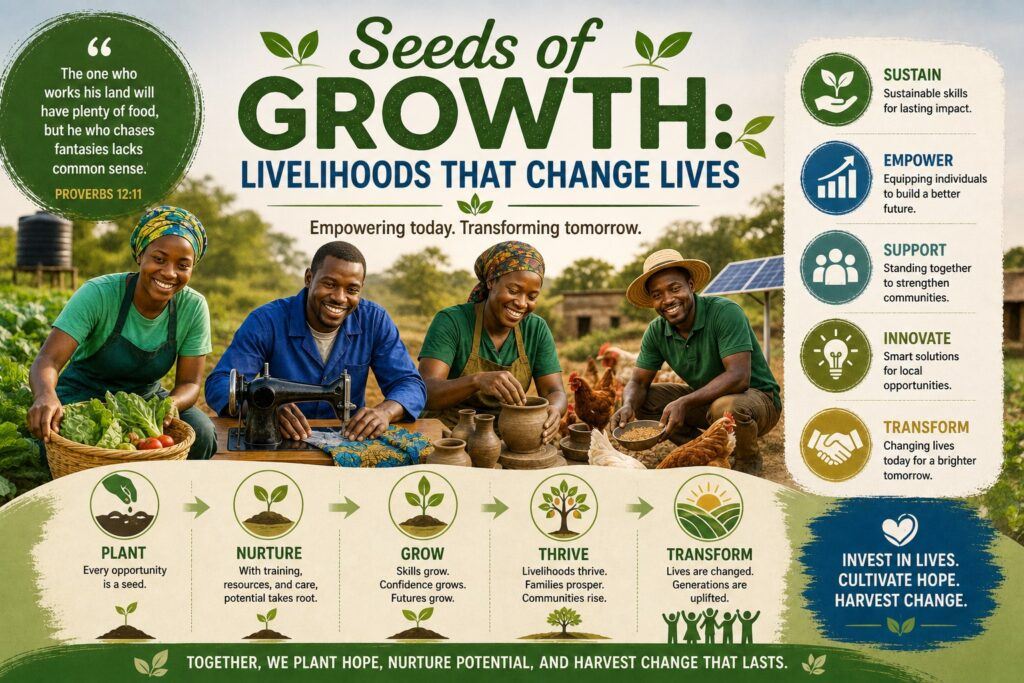
This is why “seeds of growth” is a fitting image for South Sudan. A seed is small. It looks powerless. But when planted in the right soil and protected from harm, it becomes something that feeds many people. Livelihoods are like that. A small support at the right time can change the direction of a family. A small tool can double productivity. A small training can open a new income path. A small savings group can protect a household when crisis strikes. A small improvement in market access can turn a struggle into a stable business.
But a seed also needs protection. If the seed is thrown into a flooded field, it rots. If the seed is eaten by birds, nothing grows. If the seed is planted without care, it dies. Livelihood support must therefore be serious. It must be designed with local reality in mind, and it must aim for sustainability, not only activity.
In South Sudan, the foundation of livelihoods is still land and water. Most communities depend on farming, fishing, livestock, and trade linked to these. Yet these sectors are under pressure. Conflict and displacement reduce farm access. Floods destroy crops. Drought dries grazing areas. Cattle raids disrupt movement and trade. Disease affects animals. Tools are limited. Inputs arrive late or not at all. Extension services are weak. Post-harvest storage is poor, so losses are high. Even when harvest is good, market access can be blocked by roads and insecurity.
Still, this foundation can feed the future if we strengthen it.
A livelihood that changes lives often begins with simple improvements in agriculture. Not expensive technology, but practical steps that increase yield and reduce loss. Timely seeds. Access to basic tools. Training in better planting methods that fit local soil. Support for small irrigation where possible. Better storage methods to protect grain from rain and pests. Community planning to protect farms from grazing disputes. Linking farmers to buyers so they can sell at fairer prices.
These are not glamorous interventions, but they are powerful. A farmer who harvests more becomes less dependent on relief. A household with food security becomes calmer. A community that eats becomes less vulnerable to manipulation. Hunger can make people accept harmful bargains. Food security gives people the strength to say no.
Livelihoods also include livestock, which carries both value and risk in South Sudan. Livestock is wealth, identity, and survival. It can also be a conflict trigger. Cattle raiding and revenge cycles have destroyed communities for years. But we should not treat livestock only as a conflict problem. We should also treat it as an economic asset that needs better management.
A livelihood approach can help communities shift livestock from a war issue into a stability asset. This includes animal health support, vaccination campaigns where possible, training in basic animal care, improved water access for cattle that reduces pressure on limited points, and community agreements on grazing routes and boundaries. It also includes encouraging livelihoods that reduce over-dependence on cattle for every social need, because when cattle become the only bank, every shock becomes a war risk.
Fishing is another livelihood path that is often overlooked. In riverine and floodplain areas, fishing is a lifeline, especially during hunger seasons. But fishing livelihoods also face challenges: limited equipment, unsafe access, market barriers, and sometimes conflict over fishing areas. Supporting fishing livelihoods can include basic equipment support, training on preservation methods like drying and smoking that reduce waste, and linking fishers to markets. A well-supported fishing livelihood can feed households and generate income without fueling conflict.
Beyond land and water, livelihoods also include small businesses, which are the heartbeat of many towns and trading centers. In South Sudan, small businesses are often started by women, youth, and displaced people who refuse to sit and wait. A person sells vegetables, tea, charcoal, phone credit, second-hand clothes, or small household items. These businesses look small, but they feed millions. They also keep markets alive, and markets are places where communities meet and normalize peaceful contact.
The problem is that small businesses are fragile. They operate with tiny capital. They face theft, harassment, price shocks, and sudden displacement. Many small business owners cannot access loans. Many fear formal systems because they have seen exploitation. Many do not keep records, not because they are incapable, but because nobody trained them, and daily survival feels more urgent than accounting.
This is where savings groups and basic business training can change lives.
A savings group is more than money. It is discipline. It is planning. It is mutual protection. It is accountability. It is a place where women and youth learn leadership, negotiation, and trust. A savings group can help a business survive a shock. It can help a household pay school fees without selling the last productive asset. It can help a caregiver support an orphan without collapsing. It can help a widow rebuild without being forced into dependency.
For RACBO, supporting savings groups is a practical growth strategy because it strengthens local resilience. It also fits our values. Integrity matters in savings groups because money requires trust. Resilience is built when members support each other through hardship. Innovation appears when groups find local ways to grow capital. Sustainability grows because the system belongs to the community, not to visitors.
But savings groups must be protected from corruption and capture. If group leadership becomes a private shop, trust dies. This is why training in transparent record-keeping and shared decision-making is essential. It is also why linking groups to credible oversight and mentorship can help.
Vocational skills are another major seed of growth, especially for youth. Many young people in South Sudan are energetic, intelligent, and ready to work, but they lack access to skills training that leads to real income. When youth are idle, frustration grows. When frustration grows, manipulation becomes easier. This is not an insult to youth. It is a reality of human life. A person who sees no path will take whatever path appears, even if it is destructive.
Skills training changes that equation. Carpentry. Masonry. Welding. Plumbing. Electrical work. Motorbike repair. Solar installation. Tailoring. Hairdressing. Baking. Mechanics. Phone repair. Computer basics. These skills can generate income in both rural and urban settings. They also support community recovery because skilled people rebuild homes, repair schools, fix water systems, and keep local economies functioning.
But skills training must be linked to opportunity. Training that ends with a certificate and no tools can become frustration. Training that ignores market demand can produce skills that do not sell. Training that excludes women can deepen inequality. Training that is captured by powerful families can create resentment.
A livelihood approach therefore asks practical questions. What skills are needed in this community? What services are people already paying for? What tools are required for a trainee to start earning? Can trainees be linked to apprenticeships with experienced workers? Can groups be formed to share tools and win contracts together? Can training include basic business knowledge: pricing, customer care, record-keeping, and saving?
These questions make skills training real, not symbolic.
Another livelihood area that can change lives is community-based public works linked to recovery. When roads are repaired, markets function. When drainage is improved, floods destroy less. When water points are fixed, households save time, and time becomes productive. When schools are repaired, children return to learning, and parents can focus on earning. When health facilities are supported, families lose less money to preventable sickness. These recovery actions create immediate work and long-term economic benefit.
This is why livelihoods and infrastructure are connected. A community cannot trade easily if roads are broken. A farmer cannot sell produce if transport is impossible. A small business cannot restock if supply lines are cut. A family cannot run a productive life if water is a daily crisis.
So “access” in RACBO’s identity is not only access to services. It is access to the conditions that allow livelihoods to grow: safe movement, market connection, water availability, and basic stability.
Now we must face the uncomfortable truth. Livelihoods are also harmed by unfair systems. When rules are unclear, powerful people exploit the weak. When taxes and fees are applied inconsistently, small businesses suffer. When roadblocks appear as private income points, trade becomes expensive. When corruption enters project selection, communities lose trust and cooperation. When land disputes are handled unfairly, farming collapses and conflict rises. When women’s rights to land are ignored, women’s productivity is limited. When youth are treated as threats instead of partners, youth energy is wasted.
This is why integrity is a livelihood issue. Integrity is not only a moral statement. Integrity affects the price of goods, the safety of roads, the fairness of markets, and the willingness of people to invest effort in the future. A society with high corruption is a society where people fear to build, because what they build can be stolen without consequence.
RACBO cannot fix national governance alone, but we can practice integrity locally, and that practice matters. When communities see fair targeting, transparent processes, and respectful service, trust grows. When trust grows, cooperation becomes easier. When cooperation becomes easier, livelihoods grow.
One of the most powerful livelihood supports in crisis settings is helping households manage risk. Many South Sudanese households live one shock away from collapse. A child falls sick, and the family sells productive assets. Floods come, and a small business loses everything. Conflict flares, and the household flees with nothing. These shocks are not always avoidable, but their impact can be reduced.
Savings groups reduce risk. Diversified income reduces risk. Skills training reduces risk. Better health access reduces risk. WASH reduces disease risk. Early warning communication reduces displacement risk. Fair relief reduces desperation, and desperation often pushes people into destructive choices.
This is why livelihoods work must be connected to relief and protection. If a family is starving, you cannot talk only about long-term business plans. You must stabilize them first. But if you only stabilize and never build, the same family will be starving again next season. Relief saves life now. Livelihoods protect life later. Both are required.
This is the heart of recovery.
Another major livelihood pillar is dignity. A person who earns with dignity stands differently. They speak differently. They plan differently. They resist manipulation differently. Dignity is not pride. Dignity is stability inside the heart. When a person knows they can provide, they do not need to prove themselves through violence. When a person knows they can earn, they do not need to steal from neighbors. When a youth knows he can build a life, he does not need to be recruited. When a woman knows she can support her household, she can resist exploitation.
Livelihoods that change lives are therefore also livelihoods that reduce harmful dependency. Dependency can be created by repeated crisis, but it can also be created by poorly designed support. If support teaches people that the only path is waiting for outside help, it weakens local initiative. RACBO’s optimism must be different. It must encourage communities to rebuild their own strength while receiving support. That is optimism with discipline.
So what should RACBO prioritize under this theme in 2026?
We should prioritize livelihoods that match the local economy. Farming support in farming communities. Fishing support in fishing areas. Skills training where market demand exists. Small business strengthening in trading centers. Savings groups across most settings because they build resilience almost everywhere.
We should prioritize inclusion. Women must have access to livelihood support because women carry household stability. Youth must have access because youth are the front line of either peace or conflict. People living with disabilities must not be excluded, because disability is not inability. Many can run businesses, manage savings groups, teach skills, and contribute when barriers are removed.
We should prioritize fairness and transparency in selection. Nothing kills a livelihood program faster than favoritism. Communities accept scarcity more easily than they accept unfairness.
We should prioritize linking support to practical tools. Training without tools can become frustration. Even small tool kits can change outcomes when they are managed well.
We should prioritize mentorship and follow-up. Many people start well and then face obstacles. A little guidance at the right time can prevent collapse.
We should prioritize market connection. A livelihood is not complete until there is a buyer or a customer. Market access is part of the intervention, not an afterthought.
We should prioritize peace sensitivity. Livelihood programs can reduce conflict, but if designed poorly, they can create new tension. If one group receives support and another feels excluded, resentment grows. If distribution of tools is not transparent, accusations follow. If youth are trained but jobs do not follow, frustration rises. Peace sensitivity is not optional. It is part of responsible service.
We should also prioritize storytelling that honors people’s effort. Too often, South Sudan is presented as a place of tragedy only. Tragedy is real, but it is not the whole story. There are farmers who keep planting after floods. There are women who keep trading after displacement. There are youth who choose skills over violence. There are families who adopt orphans and still run small businesses. There are communities that rebuild markets after conflict. These are seeds of growth already planted. RACBO should highlight them, not to pretend hardship is gone, but to show what is possible when people refuse to give up.
This is part of commonly best optimism: telling the truth about hardship while also telling the truth about courage.
If you are reading this as a community leader, consider what you can do for livelihoods beyond waiting for projects. You can protect markets by discouraging violence. You can mediate grazing disputes early so farming is not destroyed. You can support fair rules for water use. You can encourage youth to join skills training and apprenticeships. You can promote savings groups and protect them from corruption. You can ensure that women have a voice in livelihood planning. You can discourage road harassment that inflates prices and kills trade. You can use your authority to reduce the daily barriers that suffocate small businesses.
If you are a youth, remember that livelihood is not only money. It is identity. It is a path. It is a reason to wake up and build. Choose skills. Choose discipline. Start small if you must, but start. Join a savings group. Learn record-keeping. Learn customer care. Learn to save, even if the amount is small. Refuse shortcuts that harm others. A life built with integrity may grow slower, but it grows stronger.
If you are a woman, remember that your livelihood is also protection. It protects your children. It protects your dignity. It gives you leverage against exploitation. Organize with other women. Save together. Learn together. Share market information. Support each other in seasons of hardship. And keep insisting on fairness and respect, because women’s labor has held South Sudan together for generations.
If you are a partner or supporter, remember that livelihood work is not only about giving. It is about building systems that last. Support programs that include follow-up, that include tools, that link to markets, that strengthen savings groups, and that are designed with local realities. Avoid programs that look good in reports but leave people without a path after the event.
And if you are part of RACBO South Sudan, keep the standard high. Serve communities with integrity. Build resilience, not dependency. Use practical creativity, not empty talk. Think long-term, not only this week. Carry optimism that is proven through results, not declared through slogans.
In South Sudan, a livelihood can be the difference between a youth joining violence and a youth starting a small workshop. It can be the difference between a girl being married off early and a girl staying in school. It can be the difference between a family selling its last productive asset and a family surviving a health shock through savings. It can be the difference between a community living in constant tension and a community building shared benefit through trade.
This is why livelihoods change lives.
In 2026, let us plant seeds of growth in the places we serve. Let us protect those seeds with fairness, transparency, and follow-up. Let us water those seeds with skills, tools, and market access. Let us guard those seeds with peace, because conflict is the fastest way to destroy progress. Let us measure success not only by activities, but by households that become stable, by youth who become productive, by women whose income becomes stronger, by children who stay in school, and by communities that gain confidence in tomorrow.
A seed does not look like a harvest on the day it is planted. But if it is planted well, it becomes food. It becomes income. It becomes dignity. It becomes peace.
That is the kind of growth South Sudan needs, and that is the kind of livelihoods RACBO South Sudan should keep building this year.
Leave a Reply