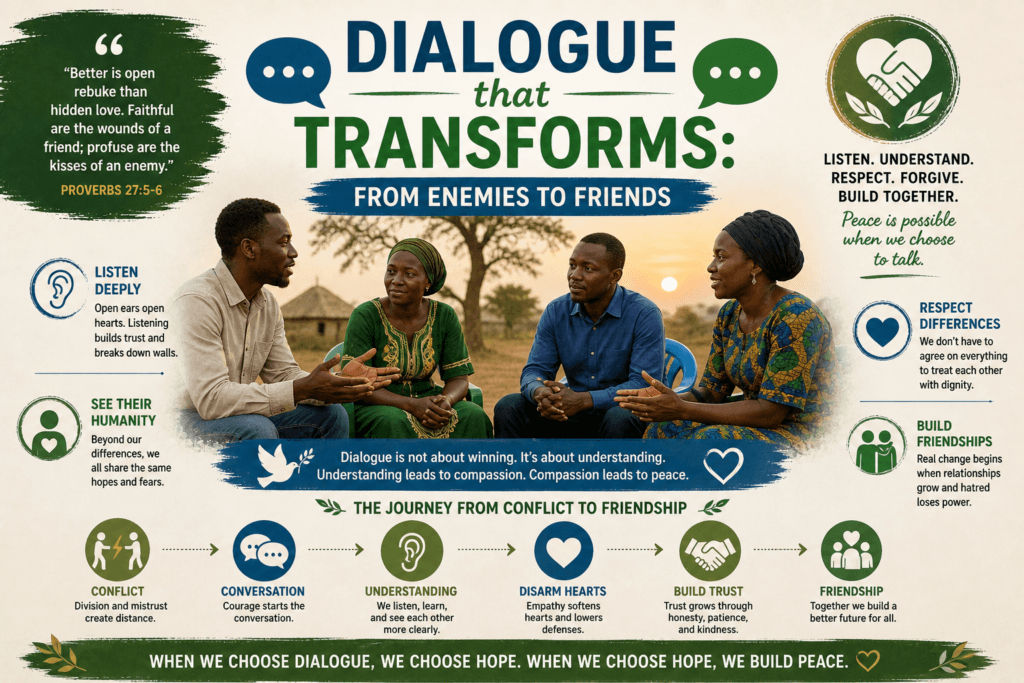
Some conflicts in South Sudan look sudden, but most of them grow slowly. A small insult becomes a rumor. A rumor becomes a threat. A threat becomes mobilization. Mobilization becomes blood. Blood becomes revenge. And after revenge, the community learns to live in a new normal where mistrust feels safer than peace.
That is why dialogue matters. Not as a polite exercise for people who already agree, but as a serious tool for stopping the chain before it reaches violence. Dialogue is one of the few things that can enter the space between fear and action. It can slow down the youth who are ready to fight. It can help elders and leaders verify truth. It can give victims a voice before anger hardens into a lifetime of hatred. It can open a door where people can see each other again as human beings, not as targets.
RACBO South Sudan serves communities through recovery and access, and we carry a steady belief that communities can rise again when integrity, resilience, smart problem-solving, and long-term thinking guide the work. Peacebuilding is not separate from that mission. Peacebuilding is what makes recovery possible. Without peace, every borehole is at risk, every school is fragile, every market is unstable, and every relief effort becomes a temporary patch that gets torn again by the next shock.
When people hear “dialogue,” some imagine endless meetings where nothing changes. That happens when dialogue is treated like a performance. But dialogue transforms when it is treated like work. Real dialogue is not just talking. It is listening with discipline. It is truth-seeking. It is naming harm without inflaming hatred. It is creating agreements that people can actually follow. It is building a new habit in a community: we face problems by speaking and verifying, not by rushing to punish.
If we want enemies to become friends, we must be honest about one thing. Friendship after conflict does not begin with laughter. It begins with safety. It begins with restraint. It begins with two sides agreeing, even with heavy hearts, that they want life more than revenge.
In many parts of South Sudan, people do not fight because they love fighting. They fight because they fear being weak. They fear being attacked again. They fear losing cattle, land, dignity, or community honor. They fear that if they do not strike first, they will be struck. Fear is a strong fuel, and it can make violence feel like wisdom. Dialogue transforms when it reduces fear by replacing imagined threats with verified facts, and by replacing isolation with communication.
A big part of conflict is not what happened, but what people believe happened. This is why rumors are so deadly. Rumors fill the gap where truth is missing. They travel faster than elders. They travel faster than official explanations. They travel faster than justice. Rumors often exaggerate numbers, intentions, and identities. They turn individuals into whole tribes. They turn accidents into plots. They turn local disputes into ethnic war.
Dialogue helps a community build a protection habit against rumors. It creates a place where people can say, “Before we move, we must know.” It creates a place where youth can hear elders ask questions. It creates a place where women can speak about the real cost of revenge. It creates a place where faith leaders can remind communities that human life is not cheap. It creates a place where community leaders can propose a calm investigation instead of instant mobilization.
But dialogue must be designed well, or it becomes another trigger. In some communities, bringing people together without preparation can cause shouting, insults, and renewed threats. That is not because people are bad. It is because pain is real. Trauma is real. Loss is real. Humiliation is real. So dialogue must respect emotional reality and still guide people toward discipline.
The first step in transforming dialogue is choosing the right people at the table. In South Sudan, if you invite only politicians, you will get political talking. If you invite only chiefs, you may miss youth energy. If you invite only youth, you may miss history and authority. If you invite only men, you may miss the stabilizing voice of women. If you invite only one clan’s leaders, the other side will suspect a trap.
A transforming dialogue includes respected elders, youth representatives who can actually influence peers, women leaders who can speak freely, faith leaders who are trusted, and local administrators where appropriate. It also includes people who have suffered directly, not only leaders who speak about suffering from a distance. Victims’ voices matter because they carry truth that reports can hide.
The second step is agreeing on purpose. Many dialogues fail because people arrive with different goals. One side wants compensation. Another wants apology. Another wants revenge but is testing the room. Another wants a public show of unity for political reasons. Another wants to protect a guilty person. Without a shared purpose, the meeting becomes a battlefield of agendas.
A simple purpose can guide a strong dialogue. It can be: stop violence, establish the truth about what happened, agree on immediate safety measures, and create a path for repair. That purpose does not solve everything in one day, but it gives the community a first bridge.
The third step is creating rules that protect dignity. Dialogue fails when people are humiliated. Humiliation makes people defensive, and defensive people do not listen well. In many South Sudanese settings, dignity is not a small issue. It is tied to identity and honor. If someone feels publicly shamed, they may leave the meeting and return to youth with a message that fuels mobilization.
So a dialogue must protect dignity while still allowing truth. This is not softness. This is strategy. It means no insults. No tribal labeling. No collective blame. No threats in the meeting. It means allowing people to speak without interruption. It means setting time limits so one voice does not dominate. It means having respected facilitators who can calm the room.
Dignity also means acknowledging pain. Many dialogues fail because one side talks as if nothing serious happened. That makes the other side feel invisible, and invisibility becomes anger. A transforming dialogue allows people to name loss clearly: people died, cattle were taken, homes were burned, women were harmed, children were displaced. Naming these truths does not create conflict. It brings conflict into the open where it can be managed.
The fourth step is verification. South Sudan’s conflicts often run ahead of facts. Dialogue transforms when it insists on verification before judgment. This is where community wisdom is powerful. Elders often know how to investigate. They know how to send trusted people to confirm a story. They know how to call witnesses. They know how to identify the individuals responsible rather than blaming whole groups. They know how to separate a criminal act from a tribal identity.
Verification is not only about truth. It is also about justice. If justice becomes collective punishment, the conflict expands. If justice becomes individual accountability, the conflict can shrink. Dialogue must keep repeating this message: we will not punish the innocent. We will not allow criminals to hide behind the name of a community. We will pursue truth and accountability in a way that protects everyone’s future.
The fifth step is immediate safety agreements. In transforming dialogue, people must leave the room with something practical. That can include agreement on ceasefire in the area, agreement on movement corridors, agreement on market access, agreement on safe grazing zones, agreement on protecting water points, agreement on restraining youth, agreement on how to handle rumor alerts, and agreement on joint monitoring.
These agreements are not perfect, but they create breathing space. Breathing space prevents the next incident from turning into war.
The sixth step is repair. Without repair, dialogue becomes empty talk. Repair can take many forms depending on local customs and the nature of harm. It can include return of stolen cattle, compensation to families, community service, rebuilding damaged homes, and public acknowledgment of wrongdoing. Sometimes repair begins with apology, but apology must be sincere and supported by action. Cheap apology without action is an insult. It tells victims that their pain is only a word.
Repair is also where integrity matters. If a community agrees on compensation and then powerful people evade it, trust collapses. If leaders promise return of cattle and then delay, youth will lose patience. Dialogue must be followed by visible steps, even small ones, so people believe the process is real.
The seventh step is follow-up. This is where many dialogues die. People meet once, shake hands, take photos, and then return to the same habits. A transforming dialogue builds a follow-up structure: a joint peace committee, regular check-ins, a clear method for handling new incidents, and a way to communicate quickly when rumors arise.
In South Sudan, follow-up is not paperwork. Follow-up is survival. The weeks after a conflict are sensitive. A small fight at a water point can reignite revenge. A rumor about a hidden attack can mobilize youth again. A single killing can erase months of dialogue. Follow-up structures help communities respond quickly and calmly.
Now, the question remains: how does dialogue turn enemies into friends?
Friendship after conflict does not mean people forget. Forgetting is not realistic, and forcing people to forget can produce bitterness. Friendship begins when people stop seeing each other as permanent threats. It begins when people can trade again without fear. It begins when women can visit each other across lines. It begins when youth can meet in sports without violence. It begins when children can attend school without hearing hate. It begins when families can bury their dead without planning revenge.
Friendship grows through repeated positive contact. Dialogue creates the first opening. Shared life builds the rest.
This is why peacebuilding must link dialogue to shared projects. Communities that work together gain a shared interest in stability. When two sides share a market, they protect that market. When they share a water point with fair rules, they protect that water point. When they repair a road together, they protect movement. When youth from both sides train together, they build relationships that make recruitment harder.
RACBO’s work in recovery and access can support these shared projects in practical ways. A peace dialogue followed by a joint clean water activity is stronger than a peace dialogue alone. A reconciliation meeting followed by a joint community cleanup is stronger than a reconciliation meeting alone. A youth peace conference followed by skills training and cooperative work is stronger than speeches alone.
This is not because projects magically remove pain. It is because shared work creates shared benefit, and shared benefit makes peace practical. Many people can tolerate each other when they benefit together. That is a basic truth of community life.
We must also be honest about the obstacles that can sabotage dialogue.
One obstacle is political manipulation. Some people benefit from division. They mobilize youth with fear. They spread propaganda. They frame every issue as tribal war. They use conflict to gain position. Dialogue threatens them because dialogue reduces their control. When communities begin to speak directly and verify facts, manipulators lose power.
This is why community-led dialogue is important. When dialogue is owned locally, it is harder to sabotage from outside. When youth and elders agree on rumor control, it becomes harder for outside voices to inflame. When women speak strongly against revenge, it becomes harder for violent pride to dominate.
Another obstacle is trauma. Trauma makes people react quickly. Trauma makes people interpret neutral actions as threats. Trauma makes people struggle to trust. If a community has suffered repeated attacks, it may believe peace is a trap. Dialogue must respect trauma and move slowly. This is where patience is a peace skill. A community cannot be forced to trust overnight. Trust is rebuilt by consistent behavior over time.
Another obstacle is injustice. Dialogue cannot be used to silence victims. If one side suffered harm and the other side refuses accountability, the dialogue becomes a cover-up. That will not transform enemies into friends. It will transform victims into quiet enemies. True dialogue must make room for accountability and repair.
Another obstacle is humiliation of youth. In some peace processes, youth are spoken to like children, even when they are the ones carrying the weapons. That approach fails. Youth must be respected, not flattered, but respected. They must be given meaningful roles in peacebuilding. They must be trained and given opportunities that reduce the attraction of violence. A youth who has purpose and income is harder to recruit. A youth who has public respect for building, not fighting, becomes a peace influencer.
Another obstacle is exclusion of women. Women often carry strong peace instincts because they feel the cost of conflict in the most direct ways. When women are excluded, peace processes lose moral weight and practical insight. Women often know which families are suffering, which youth are being mobilized, and where early warning signs are appearing. Including women is not a favor. It is a stability strategy.
Another obstacle is fake dialogue. Fake dialogue is when leaders meet but communities do not change. It is when agreements are made but not followed. It is when photos are taken but victims are ignored. It is when people speak about peace while preparing for war. Fake dialogue is worse than no dialogue because it destroys trust in peaceful methods. When communities lose trust in dialogue, they return to violence faster.
So transforming dialogue must be honest. It must be followed by action. It must be monitored. It must be corrected when it fails.
In 2026, RACBO South Sudan can play a serious role in supporting dialogue that transforms, not because we claim to be the main peacemakers, but because our service work places us close to communities. We see the pressure points. We see where tension is rising. We see where access is blocked by fear. We see how relief can trigger disputes if not handled fairly. We see how water points can become conflict points if rules are unclear. We see how youth frustration grows when opportunity is missing.
That closeness can be used for peacebuilding. We can support communities in creating safe dialogue spaces. We can support basic facilitation skills for local leaders. We can support rumor control awareness. We can encourage inclusive dialogue that brings youth and women into real roles. We can link peace dialogue to recovery steps so peace has a practical meaning in daily life.
Our guiding values must be visible in how we support dialogue.
Integrity means we do not take sides. We do not spread unverified claims. We do not exaggerate stories. We do not allow assistance to be used as a reward for violence. We do not allow local capture of benefits to fuel resentment. We treat people fairly, and we communicate clearly.
Resilience means we do not abandon a community after one meeting. We keep showing up. We keep following up. We keep supporting local structures. We accept that peace work is slow and sometimes discouraging, but we do not quit because the work is hard.
Innovation means we use simple, practical methods that fit local life. Not complicated language. Not foreign methods that ignore culture. Simple tools like joint committees, rumor alert lines, youth sports peace days, women’s peace circles, community service days, and shared livelihood activities can have strong impact when done with discipline.
Growth and sustainability mean we build local capacity. Peace that depends on visitors will collapse when visitors leave. Peace that is owned by communities can survive pressure. That is why training local facilitators and strengthening local committees matters.
Commonly best optimism means we refuse despair. We refuse the idea that South Sudan is condemned to conflict forever. We also refuse cheap optimism that pretends pain is not real. Our optimism is proved through the steady work of building trust, supporting truth, protecting dignity, and helping communities create shared benefit.
Dialogue that transforms also has a spiritual side for many communities. South Sudan is a country where faith is strong. Faith leaders often carry influence that political leaders do not. When faith leaders speak against revenge, people listen. When they speak about forgiveness with truth, they can open a door. But forgiveness must be taught responsibly. Forgiveness is not denial. Forgiveness is not pretending harm did not happen. Forgiveness is choosing not to continue harm while still pursuing truth and repair.
A wise dialogue allows faith leaders to support moral clarity without turning the meeting into a religious contest. The role of faith in peacebuilding is not to win arguments. The role is to protect life and guide hearts toward restraint and mercy.
Now, if we want to measure whether dialogue is transforming, we should look for practical signs.
We should see reduced rumor-driven mobilization.
We should see increased use of verification methods before action.
We should see markets reopening and trade increasing.
We should see safe movement improving.
We should see joint committees functioning and meeting regularly.
We should see youth participating in constructive activities and resisting recruitment.
We should see women speaking more openly in community decisions.
We should see violence incidents being handled through agreed procedures rather than immediate revenge.
We should see repair actions, even small ones, taking place.
We should see leaders being held accountable by communities for fairness.
These signs show peace is becoming normal, not just announced.
For community members reading this, the truth is simple. Dialogue is not only a leader’s job. It is also your daily choice. When you refuse to spread rumors, you are doing dialogue work. When you calm your relatives, you are doing dialogue work. When you greet a neighbor across lines, you are doing dialogue work. When you speak against hate in the market, you are doing dialogue work. When you insist on truth before anger, you are doing dialogue work.
For youth, dialogue work includes refusing to be used. It includes choosing skill and service over quick violence. It includes joining peace committees and sports events that build connection. It includes respecting women and protecting children. It includes becoming the generation that breaks the revenge chain.
For women, dialogue work includes the moral courage you already carry. It includes speaking against revenge. It includes organizing support for vulnerable families from both sides. It includes building bridges through markets and social ties. It includes raising children with respect for other communities.
For local leaders, dialogue work includes fairness, transparency, and the discipline to investigate before mobilizing. It includes stopping leaders who benefit from division. It includes creating safe spaces for people to speak truth. It includes following up and enforcing agreements.
For partners and service organizations, dialogue work includes designing services that reduce tension, not increase it. It includes transparency in targeting. It includes dignity in distribution. It includes inclusion of women and youth. It includes linking recovery efforts to peacebuilding, not treating them as separate worlds.
From enemies to friends is not a miracle that happens in one afternoon. It is a process that grows through repeated acts of discipline. It grows when communities decide that life is more valuable than pride. It grows when truth is protected. It grows when justice is pursued in a way that isolates criminals rather than blaming whole groups. It grows when shared benefit is built. It grows when the vulnerable are protected together. It grows when leadership becomes service rather than dominance.
In 2026, South Sudan does not need more speeches about unity. We need more places where people can speak safely, verify facts, repair harm, and rebuild trust step by step. We need more dialogues that end with action, not photos. We need more communities that treat dialogue as a community shield.
RACBO South Sudan is committed to that kind of work because it is part of recovery and access. Peace is not a decoration placed on top of development. Peace is the ground where development stands.
When dialogue transforms, enemies do not become friends because they suddenly agree on everything. They become friends because they choose a shared future over shared destruction. And that choice, repeated and protected, is how a nation heals.
Leave a Reply